QuickBooks Bookkeeping Cleanup HelpRead three reports before any edit
Steven Palmieri, a Tax CFO and the Entrepreneur's CFO, reads the reconciliation, the filed year profit and loss, and the open bank statements, sets payday up with the provider you already run, and prepares the return from a month that matches.
The company file can stay where it is for another night. The three reports are enough to say which month is still true.

Name the last matched month
The Tax CFO way with a cleanup.
The three reports count what already happened. A Tax CFO decides what the next month is for, and the cleanup stops at that line.
The filed year has a number.
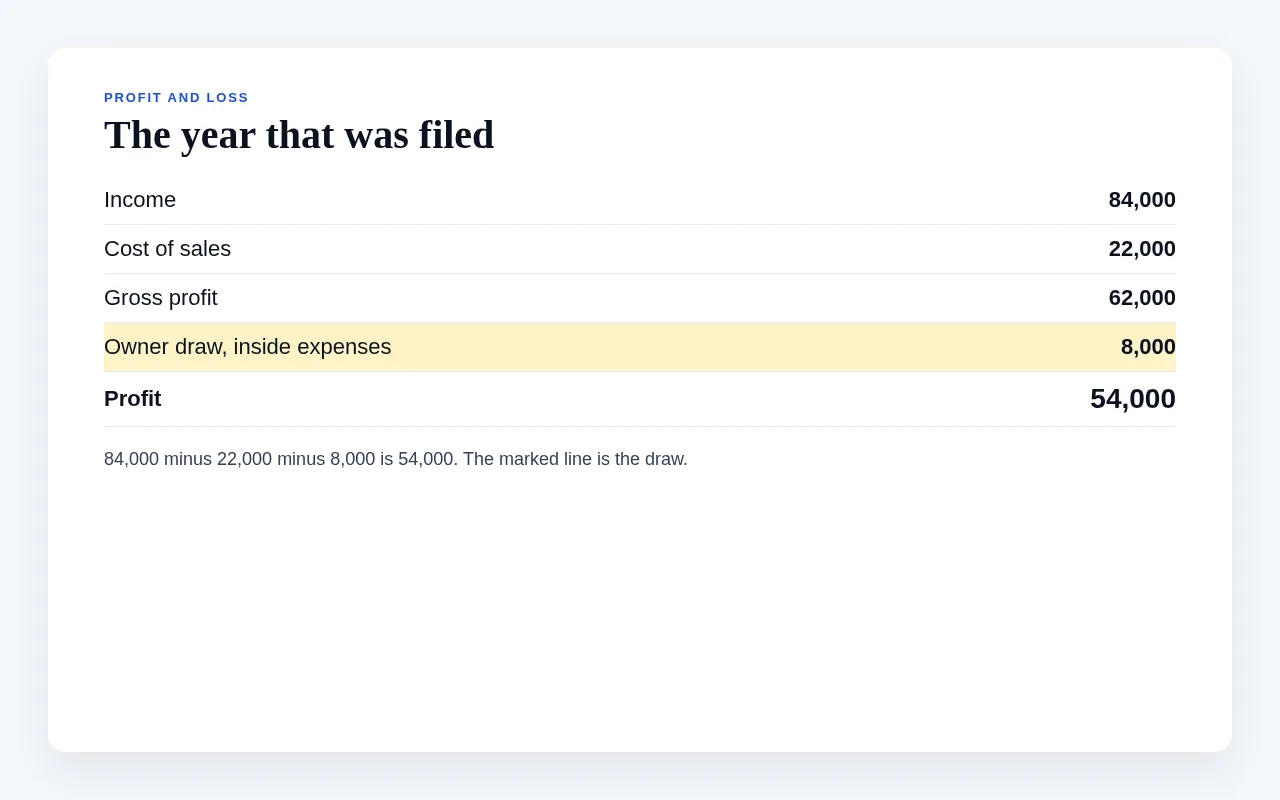
The profit on the return you already filed is the figure we trust first. Everything after that year is still open, and a newer export does not replace a year someone already signed.
Click to read the filed year ›Tap to read the filed year ›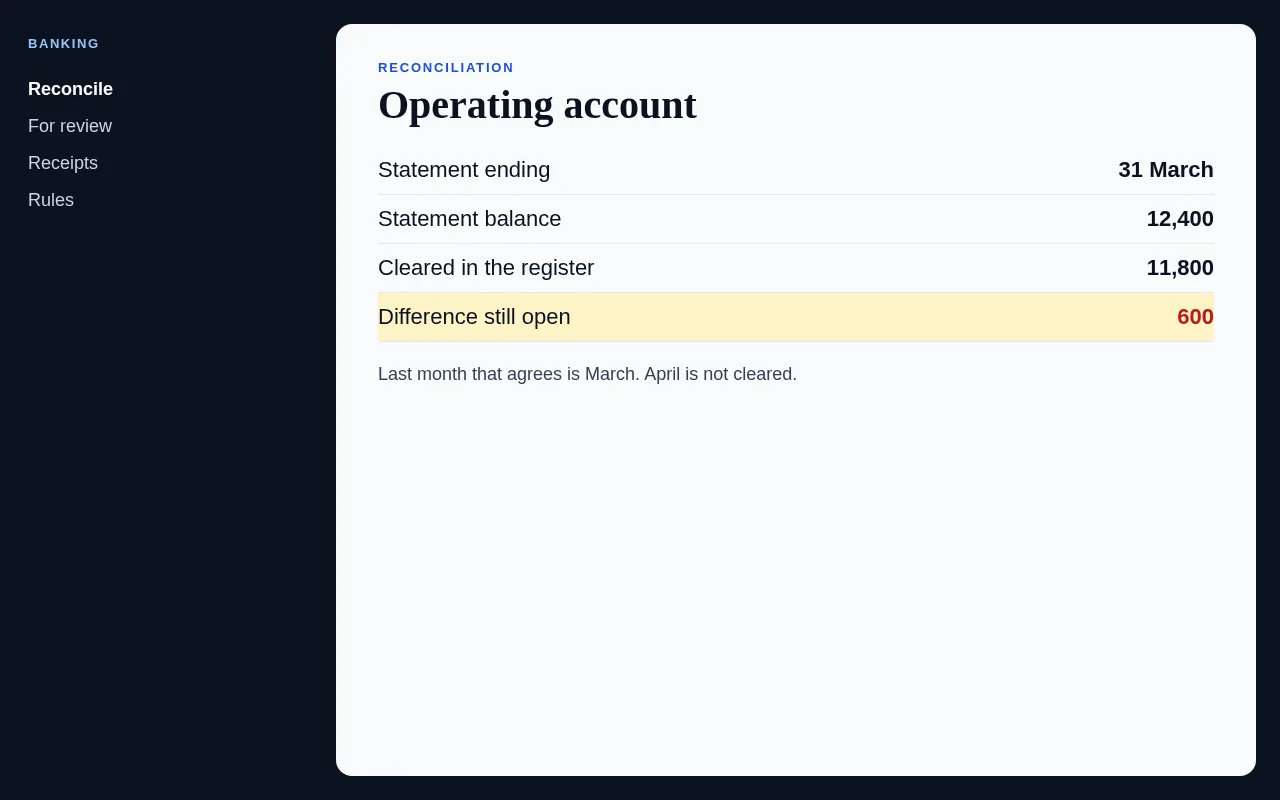
One file, if time is short.
If you can pull only one report tonight, pull the reconciliation for the operating account. It names the last month that already agrees.
Click to see which file first ›Tap to see which file first ›
Picture a Tuesday.
A teaching picture, not a company we know. March is the last match, the profit is the filed year, and the statements cover the months after.
Click to see the Tuesday picture ›Tap to see the Tuesday picture ›The login can stay home.
We can read copies of the three reports. The company file does not have to travel, and nobody has to press Reconcile tonight.
Click to read about the login ›Tap to read about the login ›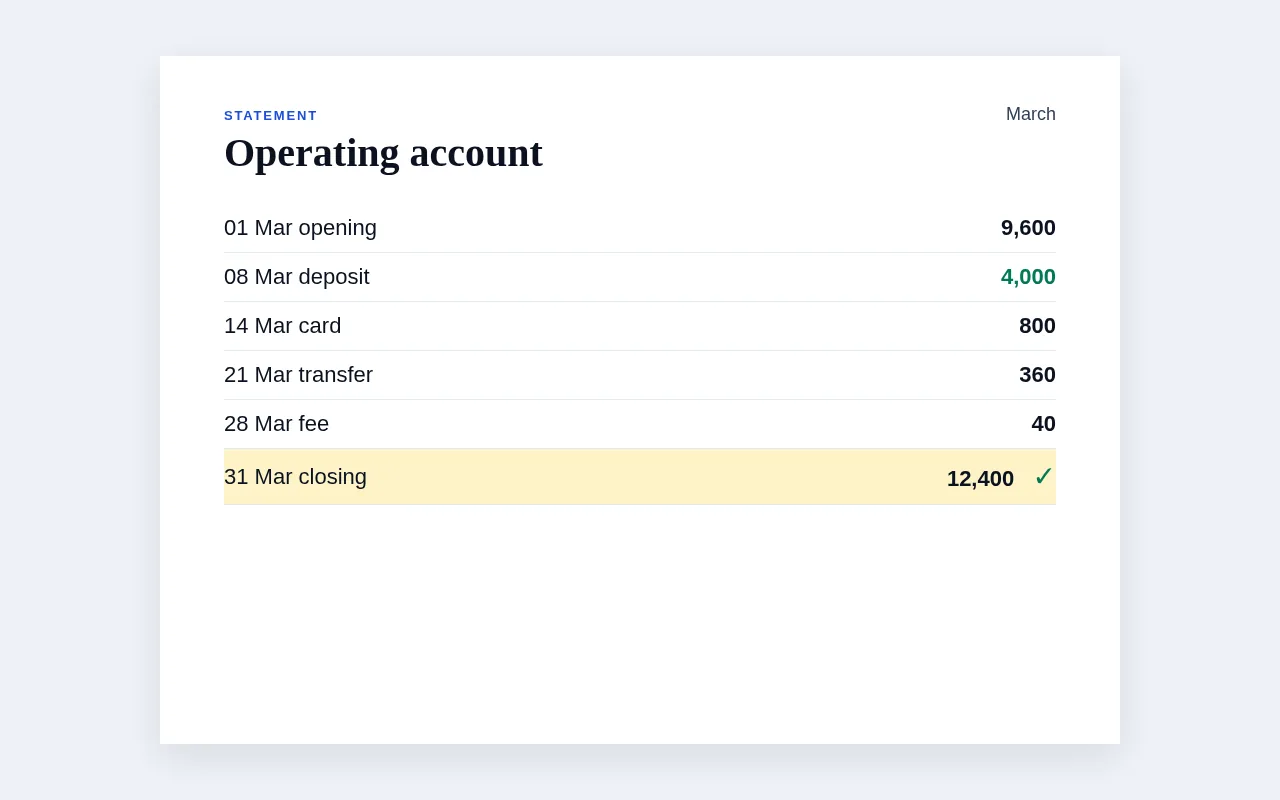
A month ends when it ties.
A month ends when the statement agrees. Not when the software marks the year done, and not when the calendar turns. The tick beside the closing balance is the end of that month.
Click to read the questions ›Tap to read the questions ›
Who reads the three reports.
The person who reads the three reports is the person on the call. The month in the file still has to agree with the statement before anyone talks about changing a line.
Click to meet the practice ›Tap to meet the practice ›Six reports, six jobs
An open file left through a long winter is harder to read in the spring.
1Reconciliation stops early
The operating account
The report names the last month the screen and the statement agreed. Later months can wait until that month is named.
2Filed year profit
The return already sent
The profit and loss for the year that was filed is the number the return used. A newer export is a different year.
3Open month statements
The bank, not the screen
Statement files for the months after the last match are the outside number. The register is the inside number.
4A feed that went quiet
Missing rows
A quiet feed is missing lines. An unmatched month still has lines and no tick. Those are different repairs.
5Draws inside expenses
The owner, not a vendor
Money the owner took that landed in expenses changes the profit the return used. Circle the line. Do not recode it tonight.
6Sales tax that does not match
The payable account
The payable on the balance sheet and the amount sent with the sales tax return should be the same story. A mismatch is a report, not a new company file.

Steven Palmieri, Tax CFO.
Those three reports are Steven Palmieri's reading, as Tax CFO, the Entrepreneur's CFO. The practice is in Dallas. Owners anywhere join by video with the same three reports.
What the reconciliation is actually for.
The reconciliation report for the operating account is the page that says the register and the bank agreed through a named month. It is not a request to press Reconcile again. If the report ends in March, March is the last month we will treat as true until a later statement is in hand.
Bring the last month the operating account matched a statement. If you are not sure, say so. Guessing a month is how a cleanup starts in the wrong place. Each card names one report. Name the last month that already agrees before the next season starts.
A cleanup that starts by editing April, while March is the last matched month, builds on a number that has not been proved. We would rather see the report first. The company file can stay closed while that report is read.
A quiet feed is not the same as an open month.
When the bank feed stops, the rows never arrive. The For review list is short because the lines are missing. An unmatched month is the opposite. The rows are there, and nobody has accepted them. One needs the missing lines. The other needs a match, not a new download.
Owners often treat both as the same red mark on the banking screen. They are different repairs, and the reconciliation report is what tells them apart. Name the screen, the quiet feed or the unmatched month. Do not exclude a line just to make the screen look calm.
Draws that landed in expenses.
Money the owner took is not a vendor bill. When it is coded to an expense, the profit on the filed year is lower than the return may have used, or higher, depending on which year absorbed the line. The fix is to see the line, not to recode it at midnight.
Circle it on the profit and loss and leave the company file alone. On the call we will say whether that line belongs in equity. A draw is not payroll, and it is not a cleanup by itself.
Sales tax payable and what was sent.
Sales tax collected for a state sits in a payable, and the return that state received should tell the same story as the balance sheet. The rate is whatever that state and that city actually charged. The payable account should match the returns that were filed, and the source is those returns, not a guess from the software screen.
A mismatch is a report to read, not a reason to start a second company file. If the payable is large and the returns were small, something was collected and not sent, or it was coded to the wrong account. We want the balance sheet line and the filed returns side by side.
What we will not click.
We do not delete rows to force a month to zero. We do not mash a match because the amounts are close. We do not open a new company file because the old one feels messy. Those clicks are how a year that was already filed becomes a year nobody can explain.
What the first call hands you is a reading of those three reports. If the month can be closed from them, we name the month. If it cannot, we name what is missing. Payday setup, when it is needed, goes to the provider you already run. This practice does not run payday.
How a matched month becomes the return.
A month we will call closed is one where the operating account matches a statement and the open items are listed. That month is what the return should be able to stand on. A profit and loss pulled for a later date, with the earlier months still open, is a different document.
A Tax CFO reads that count and decides what the next month is for, a loan, a sale, the return, or a quieter year. Then the month closes every month, so the file does not need another rescue.
A corporation return is generally due on the fifteenth day of the fourth month after the year ends, and estimated tax falls on a quarterly calendar through the year. The books have to be readable before that return is a real number. A profit pulled from open months is not the figure the return should stand on. The dates are the federal calendar. They tell you when a matched month has to exist.
Send the open months
Name the last month the operating account matched, and say which of the three reports you already have.